Engineering Architecture
API Governance: Moving Beyond Manual Gatekeeping
A technical blueprint for scaling security without breaking developer velocity.
Modern API Governance is usually where developer productivity goes to die. In most organizations, "governance" means a 40-page PDF of naming conventions and a monthly manual audit that catches 5% of security risks. This approach fails because it treats governance as a static gate rather than a continuous, automated feedback loop. If your governance strategy doesn't live in the CI/CD pipeline, you aren't governing; you're just documenting your technical debt.
The API Sprawl Problem
Engineering teams move fast. They deploy microservices, experimental lambdas, and internal-only tools daily. This speed creates API Sprawl—a landscape where undocumented "shadow" APIs outnumber sanctioned ones. Manual API Governance cannot track this growth. Without automated discovery, you lose visibility into your OpenAPI/Swagger definitions, making it impossible to enforce OWASP API Top 10 compliance or standard Remediation workflows.
Typical Governance Failure: The "Shadow" Endpoint GET /internal/v1/debug-user-export [NO AUTH] X-Legacy-Header: bypass-gateway HTTP 200 OK ← Endpoint exists but is unknown to governance tools.
Automation: The Only Way Forward
Effective API Governance requires shifting from subjective human review to objective machine enforcement. This means scanning code—not just traffic—to find vulnerabilities before they reach Runtime Protection layers. By integrating security into the CI/CD security stack, you can identify BOLA, injection risks, and misconfigured middleware at the pull-request stage.
Comparison: Governance & Security Workflow
Feature | ApiPosture Pro | 42Crunch / Snyk | Legacy Manual Audit |
|---|---|---|---|
Setup Time | < 60 seconds | 20 - 60 minutes | Weeks |
Execution | 100% Local / Offline | Cloud SaaS Dependent | Human Meetings |
Actionable Fixes | Direct Code Location | General Platform Advice | Spreadsheet/Email |
The Core Pillars of Modern API Governance
1. Continuous Discovery: If you don't know an API exists, you can't govern it. Automated tools must scan your repositories to identify every entry point, regardless of whether it's in the OpenAPI spec yet.
2. Policy as Code: Stop using PDFs. Use configuration files to define what "secure" looks like. If a developer tries to commit an endpoint without authentication, the build should fail. This is the only way to scale API Governance across hundreds of repos.
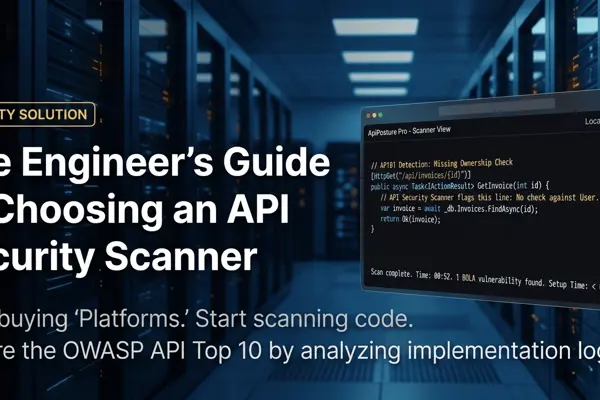
3. Immediate Remediation: Security findings without context are useless. Governance tools should point to the exact file and line number in the source code, providing the fix directly to the engineer or their AI coding assistant.
Fix Your API Posture in 2 Minutes
Ditch the "Enterprise Bloat." Get sub-second security discovery with actionable fixes that run entirely on your local machine.