Category: Product Pillar
API Posture Management: Beyond the Swagger UI
Eliminate API Sprawl, hard-code security into your CI/CD, and achieve sub-second discovery.
Modern engineering teams ship fast. In the race to deploy microservices, the gap between what is documented and what is actually running in production grows daily. API Posture Management is the technical discipline of closing that gap. It is not about a "firewall" or a "gateway"; it is about deep visibility into your source code, ensuring that your implementation matches your OpenAPI/Swagger definitions and that every endpoint follows strict OWASP API Top 10 compliance.
The Fallacy of "Gatekeeper" Security
Traditional security tools act as gatekeepers. They sit at the edge, sniffing traffic, and hoping to catch a malicious payload. This is reactive and, frankly, antiquated. If you are waiting for Runtime Protection to catch a BOLA (Broken Object Level Authorization) exploit, the data has already left the building.
Effective API Posture Management requires a "Shift-Left" mindset. We don't want to see your traffic; we want to see your Program.cs. We want to know why your [Authorize] attribute is missing on a DELETE method before it ever reaches a staging environment.
Combating API Sprawl and Shadow Endpoints
API Sprawl is the silent killer of secure architectures. It happens when developers spin up "test" controllers, legacy versions are left un-deprecated, or microservices are deployed without being registered in the central registry. These Shadow Endpoints are the primary targets for attackers because they often bypass standard authentication middleware.
›Sub-second Discovery: ApiPosture uses the Roslyn compiler engine to map your entire attack surface in milliseconds. It doesn't crawl URLs; it understands C# syntax. It finds routes that aren't even in your Swagger UI yet.
Deep Dive: The OWASP API Top 10 Rules Engine
ApiPosture Pro isn't just a linter. It’s a specialized security engine. While generic SAST tools might flag a "potential SQL injection," we look specifically at the API Posture Management context.
AP101: Broken Access Control (BOLA/BFLA)
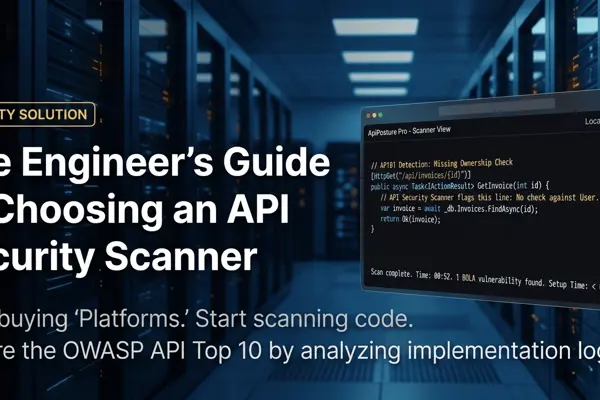
Our engine scans method bodies to ensure that if a user requests /api/orders/{id}, there is an ownership check. We detect "naked" database queries that don't filter by UserId.
AP105: Security Misconfiguration
We catch AllowedHosts: * in your appsettings.json and check if your Swagger/OpenAPI documentation is exposed in production environments via environment-guard checks in Startup.cs.
AP108: SSRF Patterns
Detecting HttpClient calls that take user-controlled input without validation—preventing your API from being used as a proxy to attack internal services.
Market Comparison: Efficiency vs. Bloat
Feature / Criterion | ApiPosture Pro | 42Crunch | Snyk |
|---|
Setup Time | < 60 seconds | 30-60 min | 10-20 min |
100% Local Scan | Yes (Zero data leaks) | No (SaaS Cloud) | Partial |
Method Body Inspection | Yes (Deep Roslyn) | No (Mostly Meta) | Partial |
Cost | $20 / Month | Enterprise $$$ | Usage-based $$ |
Automating Remediation: Stop Searching, Start Fixing
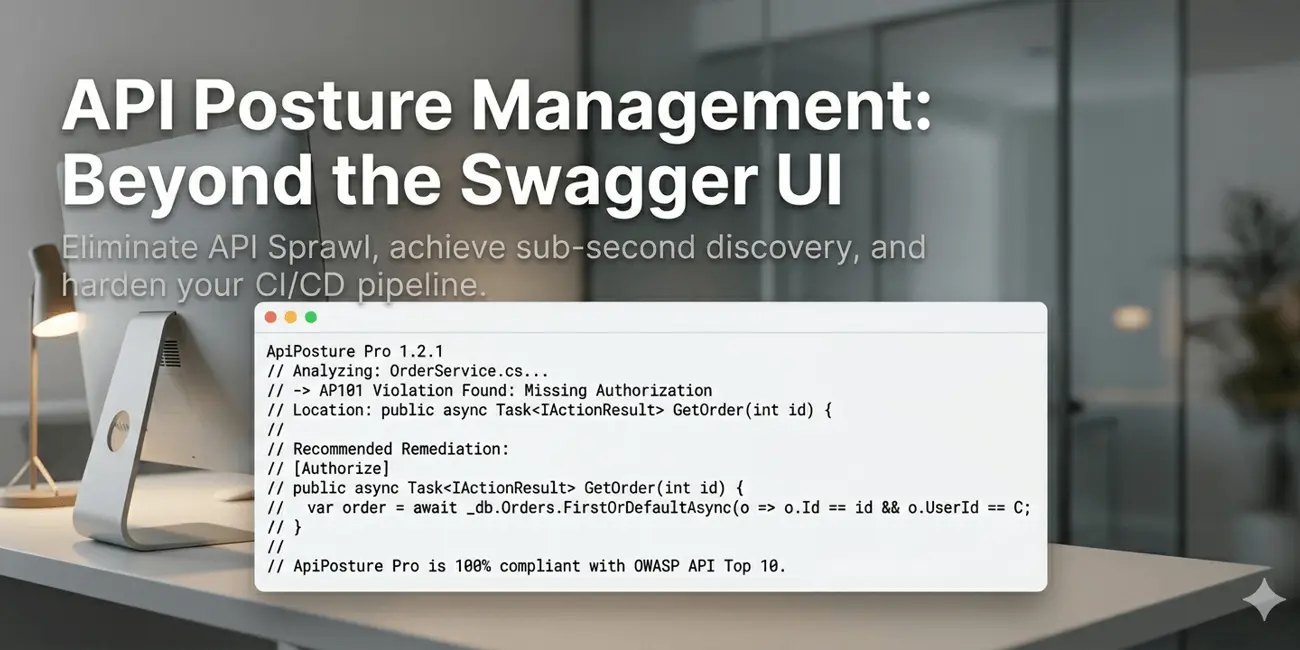
We hate "Risk Reports" as much as you do. A 50-page PDF is useless to an engineer in a sprint. ApiPosture focuses on Remediation. When our CLI finds a vulnerability, it doesn't just describe it; it provides the actionable fix.
// AP101 Violation Found: Missing Authorization
[HttpGet("{id}")]
public async Task<IActionResult> GetOrder(int id) { ... }
// Recommended Remediation
[Authorize]
[HttpGet("{id}")]
public async Task<IActionResult> GetOrder(int id) {
  var order = await _db.Orders.FirstOrDefaultAsync(o => o.Id == id && o.UserId == CurrentUser.Id);
}
Governance at Scale: CI/CD Security
For the Security Architect, API Posture Management is about setting the "Guardrails." By integrating ApiPosture into your CI/CD pipeline, you enforce a global security standard. You can configure the CLI to return a non-zero exit code if any Critical or High severity issues are found, effectively blocking insecure code from ever merging into your main branch.
Unlike Runtime Protection, which might fail or be bypassed by clever obfuscation, CI/CD security with ApiPosture relies on the deterministic logic of the compiler. If the code is unsafe, the build fails. Period.