API Security Audit Checklist for SOC 2, ISO 27001, and OWASP
When a compliance auditor arrives, they don't just look at your high-level policy documents; they look for evidence of enforcement. In modern cloud-native environments, that evidence lives in your code. An API security audit checklist is no longer just a "nice-to-have"—it is the difference between a clean SOC 2 report and a qualified opinion that stalls your enterprise sales deals.
The challenge is that APIs are dynamic. Developers ship new routes daily, and traditional manual audits can't keep up. To satisfy ISO 27001 or the OWASP API Top 10, you need a checklist that covers the entire lifecycle, from secret management to "API sprawl" detection.
Use this technical checklist to evaluate your current posture and identify gaps before your official audit begins.
The Master API Security Audit Checklist
Verify that all endpoints (except explicitly public ones) require a valid identity token. Are you using modern standards like OAuth2/OIDC? Are you validating JWT signatures and expiration dates on every request?
Does the code perform resource-level ownership checks? An audit must prove that User A cannot access User B's data by guessing a GUID or Integer ID. This is the #1 cause of SOC 2 logical access failures.
Do you have a comprehensive inventory of all publicly accessible routes? Auditors look for "Leaky APIs" where developers forgot the [Authorize] attribute on a sensitive method.
Are database connection strings, API keys, or JWT signing secrets hardcoded in appsettings.json or method bodies? This is a direct violation of ISO 27001 A.10.1.1 (Key Management).
Are there "debug" or "internal-only" routes left in production code? API sprawl increases your attack surface beyond what is documented in your official OpenAPI/Swagger spec.
From Manual Checklist to Automated Scan
Running this API security audit checklist manually across a large microservices architecture is impossible. To maintain continuous compliance, you must move the audit into your terminal and your CI/CD pipeline.
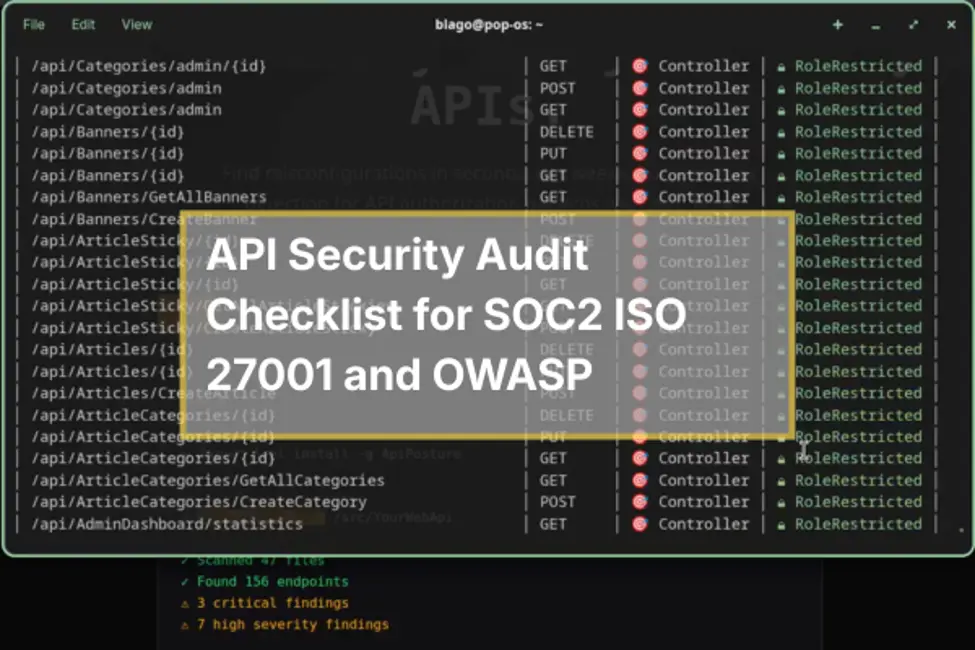
ApiPosture Pro automates these checks by using static code analysis to "see" your API logic exactly as an auditor would. It finds the missing ownership checks (AuthZ), identifies hardcoded secrets, and maps your entire endpoint inventory—including the ones you didn't know you had.
To audit your entire source directory for these risks, simply run:
apiposture scan ./src
In seconds, you receive a full audit report mapping every finding to a specific file and line number. This output serves as perfect "Evidence of Control" for your SOC 2 or ISO 27001 documentation, showing that you are proactively managing your API security posture.
Checklist vs. ApiPosture Automation
Checklist Item | Manual Audit Effort | ApiPosture Rule |
|---|---|---|
Broken Authorization (BOLA) | Weeks of code review | AP101 |
Secret Exposure | Grepping config files | AP201 |
Shadow API Discovery | Manual spec comparison | Scan Engine |
Logging & Auditing | Tracing deletion logic | AP107 |
Conclusion: Don't Wait for the Auditor
A successful API security audit is won in the months leading up to the assessment. By implementing a consistent checklist and automating the verification with ApiPosture Pro, you ensure that security is built-in, not bolted-on.
Protect your company’s reputation and your customers' data by moving to an automated audit lifecycle today.
Get Started with ApiPosture Pro »
Technical Resources & Security Guides
SOC 2 Checklist: For a deep dive into Trust Services Criteria mapping, see our Guide to API Security for SOC 2 Compliance.
OWASP Baseline: Your audit checklist starts with the Top 10; learn more in How OWASP API Compliance Helps with Audits.
Control Definitions: Understand the "why" behind the checklist items in our guide to Essential API Security Controls for Audits.
Contract Security: Audit your documentation as well as your code by Hardening OAS API Definitions.