Spring Boot Rate Limiting with Bucket4j & Redis
The Problem: The "Fair Use" API Crisis
In a microservices architecture, a single aggressive client or a runaway automated script can saturate your database connections and thread pools. Without Spring Boot Rate Limiting, your API is vulnerable to OWASP API4:2023 (Unrestricted Resource Consumption). If your API provides expensive operations—like complex data exports or heavy encryption—a lack of throttling becomes a Denial of Service (DoS) vulnerability.
For enterprise teams, rate limiting is also a SOC2 requirement for Availability. You must prove that your system can maintain service levels even under stress. Relying on "hope" is not a strategy; you need an Audit Trail Integrity that shows when and why requests were throttled.
Technical Depth: The Token Bucket Algorithm
The industry standard for Java throttling is the Token Bucket algorithm, often implemented via the Bucket4j library. Unlike a simple counter, a token bucket allows for "burstiness"—permitting a user to make a few quick requests while maintaining a steady long-term average rate.
Distributed Throttling with Redis
A common mistake in Java API security is implementing rate limiting in the application memory. If you have ten instances of a service behind a load balancer, each instance will have its own "bucket," effectively multiplying your allowed limit by ten. To enforce a true global limit, you must use Redis as a centralized state store. This ensures Autonomous Authorization of traffic across your entire API Sprawl.
Rate Limiting vs. Circuit Breaking
While rate limiting protects you from the client, circuit breaking (using Resilience4j) protects you from downstream failures. A complete DevSecOps strategy uses both. Rate limiting stops the flood at the door, while circuit breaking prevents your service from dying if a dependency (like a third-party payment gateway) slows down.
Implementation: Hardening Spring Boot Endpoints
To achieve Evidence-based Remediation, you should implement rate limiting as a cross-cutting concern, usually via a Filter or an Aspect (AOP), to ensure no new route is born unprotected.
Client Identification: Throttling by IP is unreliable in the era of VPNs. Use the JWT
subclaim or an API Key to identify the unique consumer.Dynamic Limits: Tier your limits based on the user's plan (e.g., 100 req/min for Free, 5000 req/min for Enterprise).
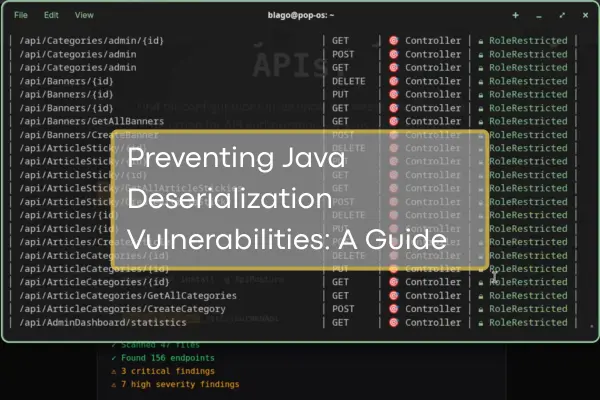
Visibility: Use ApiPosture Pro to discover which endpoints have been missed by your rate-limiting decorators (AP104).
// Example: Bucket4j Configuration with Redis @Bean public ProxyManager proxyManager(LettuceConnectionFactory connectionFactory) { RedisClient redisClient = RedisClient.create(connectionFactory.getRequiredConnection().getNativeConnection()); return LettuceBasedProxyManager.builderFor(redisClient) .withExpirationStrategy(ExpirationStrategy.fixedTimeToLive(Duration.ofHours(1))) .build(); }
Technical Comparison: ASPM Visibility vs. Static Config
Auditors often ask: "Is every endpoint protected against DoS?" Checking hundreds of YAML files manually is error-prone. ApiPosture Pro provides sub-second discovery of unprotected routes across your entire fleet.
Throttling Metric | ApiPosture Pro | Standard API Gateway |
|---|---|---|
Unprotected Route Alert | Automatic (AP104) | Requires manual audit |
Logic Reachability | Verifies code-level presence | Traffic-only (Lacks context) |
Local Verification | ✓ 100% Privacy Focused | X - Often requires cloud logs |
Conclusion: Enforcing Resource Fair Use
Protecting your Java API security posture means being proactive about traffic management. By implementing Bucket4j with Redis and using CI/CD security to flag missing limits, you ensure your application remains available under any load. Don't let one bad actor bring down your enterprise ecosystem.
Continue hardening your Spring Boot apps with our guides on Spring Boot JWT Auth or Java Supply Chain Security.