Spring Boot Security: JWT Authentication & RBAC
The Problem: The Complexity of the Security Filter Chain
The primary challenge with Spring Boot security is the sheer complexity of the Filter Chain. Developers often implement JWT (JSON Web Token) authentication correctly but fail at the RBAC (Role-Based Access Control) layer. It is common to see an API that successfully authenticates a user but fails to verify if that user has the permission to access a specific resource, leading to BOLA (Broken Object Level Authorization)—the #1 risk in the OWASP API Top 10.
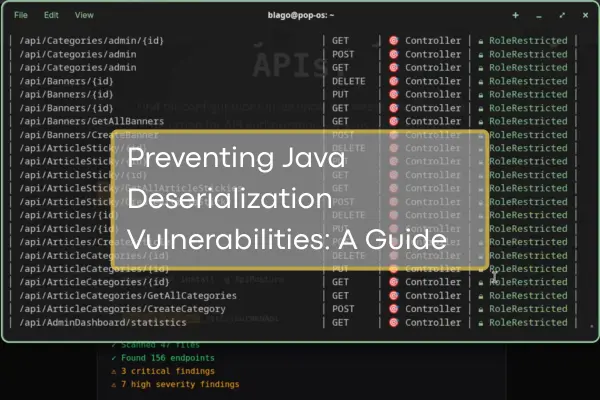
During a Java API security audit, auditors look for "Shadow Endpoints"—routes that were added for debugging or by a different team that accidentally bypassed the global security configuration. Without Autonomous Authorization checks at the method level, these routes become open doors for attackers.
Technical Depth: Securing the Method Level
Global security configurations in SecurityFilterChain are fragile. If a developer changes a URL path in a controller but forgets to update the security config, the endpoint may become public. The professional DevSecOps approach is to move security as close to the data as possible using Method Security.
Enabling Global Method Security
By using @EnableMethodSecurity, you can use annotations like @PreAuthorize directly on your service or controller methods. This ensures that even if the URL routing changes, the security requirement remains attached to the logic. This is essential for maintaining Audit Trail Integrity, as it clearly documents who can do what directly in the code.
JWT Validation Pitfalls
Many Java implementations use symmetric keys (HS256) stored in application.properties. If this file is accidentally checked into Git, your entire security posture collapses. A hardened Java API security strategy uses asymmetric keys (RS256) and validates the iss (issuer) and exp (expiration) claims strictly to prevent token replay attacks.
Implementation: Hardening Spring Security
To ensure Continuous Compliance, your Spring Boot application should implement a multi-layered defense strategy that provides Evidence-based Remediation data for SOC2 auditors.
Stateless Sessions: Ensure
SessionCreationPolicy.STATELESSis active to prevent CSRF and session fixation attacks.Granular RBAC: Use
hasRole('ADMIN')or custom permission evaluators instead of simple "is authenticated" checks.eBPF-powered discovery: Use tools that can see through the Spring abstraction to verify that every active bean and endpoint is actually covered by a security filter.
// Secure Controller Pattern with RBAC @RestController @RequestMapping("/api/v1/orders") public class OrderController { @GetMapping("/{id}") @PreAuthorize("hasRole('USER') and #ownerId == authentication.principal.id") public Order getOrder(@PathVariable Long id, @RequestParam Long ownerId) { // ApiPosture AP101 check: ensures ownership check is present return orderService.findById(id); } }
Technical Comparison: ASPM vs. Manual Configuration
Manually verifying that 50+ controllers have the correct @PreAuthorize tag is impossible to sustain. ApiPosture Pro provides sub-second discovery of missing authorization decorators across your entire Spring Boot project.
Security Metric | ApiPosture Pro | Spring Security Defaults |
|---|---|---|
Missing Auth Detection | Automatic (AP101) | None (Silent Fail) |
Weak Crypto Check | Flags MD5/SHA1 (AP102) | Requires manual audit |
Local Analysis | ✓ 100% On-Prem/CLI | N/A |
Conclusion: Mastering Enterprise Authorization
Hardening a Spring Boot API is a journey from simple authentication to robust, verifiable authorization. By integrating CI/CD security into your Maven or Gradle build, you ensure that every code change is scanned for Broken Access Control and Security Misconfigurations (API5:2023). Don't just secure your API; prove it's secure with a verifiable Audit Trail Integrity.
/actuator endpoints. An exposed /heapdump can contain plaintext JWT secrets or database credentials, which is a critical finding in any SOC2 audit.Continue building your security knowledge with our guides on Java Supply Chain Auditing or learn about Spring Boot Rate Limiting.