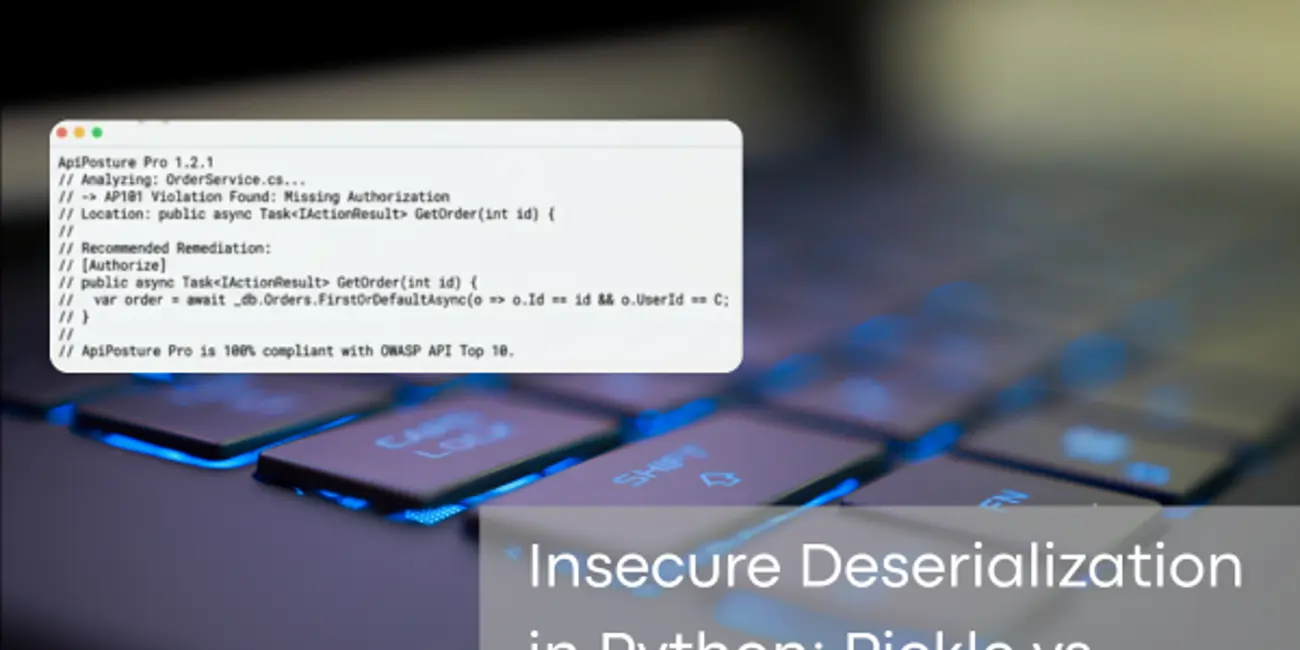
Insecure Deserialization in Python: Pickle vs. Pydantic
The Problem: The Lethal Convenience of Python Deserialization
In many legacy systems, Insecure Deserialization in Python remains a primary vector for Remote Code Execution (RCE). The pickle module is notoriously dangerous because it doesn't just store data; it stores instructions on how to reconstruct Python objects, including state and arbitrary logic. If your API accepts pickled data from a client, you have essentially handed over your shell to the internet.
Failing to address this leads to an immediate Audit failure during SOC2 or ISO 27001 reviews. Most modern "automated" scanners miss these patterns because they focus on surface-level OpenAPI/Swagger definitions rather than the underlying data handling logic. Without Evidence-based Remediation, these vulnerabilities persist as Shadow APIs or hidden logic in background workers.
Technical Depth: Pickle RCE vs. Pydantic Validation
The pickle module's reduce method allows an attacker to specify a callable and its arguments that will be executed upon unpickling. This is the definition of "insecure by design" for untrusted inputs. Contrast this with Pydantic, which enforces strict type hints and schema validation without executing arbitrary bytecode.
Exploiting the Pickle Protocol
An attacker can craft a payload that uses os.system to initiate a reverse shell the second your backend calls pickle.loads(). This isn't a bug in Pickle; it's exactly how the protocol is designed to work. For a Python API security audit, seeing import pickle in an API route is a critical red flag that requires immediate Remediation.
Pydantic: The Secure Alternative
Modern frameworks like FastAPI utilize Pydantic to ensure that incoming JSON matches a predefined model. This provides Autonomous Authorization at the data layer—if the input doesn't match the schema, it is rejected before it ever reaches your business logic. This eliminates the risk of Insecure Deserialization in Python by moving from "executable state" to "validated data."
Implementation: Automating Compliance in CI/CD
Securing your data layer requires CI/CD security that can identify dangerous imports and insecure TypeNameHandling patterns. A 2-minute setup of specialized security tooling can scan your entire repository for these patterns, mapping them to OWASP API Top 10 findings (specifically API8:2023 - Insecure Consumption of APIs).
Step 1: Audit all instances of
pickle,marshal, andshelve.Step 2: Replace untrusted deserialization with
Pydanticmodels or standardjson.loads().Step 3: Ensure Audit Trail Integrity by logging failed validation attempts as potential injection attacks.
Technical Comparison: Precision over Enterprise Bloat
General-purpose security platforms often drown engineers in "low-priority" alerts while missing deep logic flaws like insecure serialization. You need a tool that provides sub-second discovery of the code that actually matters.
Requirement | ApiPosture Pro | Legacy SaaS Platforms |
|---|---|---|
Deserialization Depth | Inspects method bodies for Pickle/Marshal use | Often limited to library-level dependency scans |
Setup Speed | < 60 seconds (1 CLI command) | 30 - 60 minutes |
Local Privacy | 100% Local (Code stays on-prem) | Requires cloud spec upload |
Conclusion: Moving Toward Schema-First Security
Addressing Insecure Deserialization in Python is not about finding better ways to use Pickle; it’s about removing it entirely from your API surface. By implementing Continuous Compliance via Pydantic and automated scanning, you eliminate the risk of RCE while streamlining your audit evidence. Stop managing API Sprawl and start enforcing data integrity at the source.
hmac. Better yet, migrate to a binary format like Protobuf that doesn't execute code on load.To understand how this fits into your broader security strategy, see our Python API Security Ecosystem Guide or explore our recent deep dive on Python JWT Security.


