API Security Controls Required for SOC 2 Compliance
Achieving API security SOC 2 compliance is often the most significant hurdle for growing SaaS companies. As organizations move away from monolithic architectures toward microservices, the surface area for "Logical Access" risks expands exponentially. In a modern environment, your API is no longer just a technical interface; it is the primary gateway to your customer's most sensitive data.
SOC 2 is based on the Trust Services Criteria (TSC), which provide a framework for managing customer data based on five principles: Security, Availability, Processing Integrity, Confidentiality, and Privacy. For engineering teams, the "Security" principle (Common Criteria) is where the rubber meets the road. Without a dedicated strategy for API security, proving compliance during a Type II audit period becomes an exercise in manual, error-prone evidence gathering.
This guide breaks down exactly how API security fits into the SOC 2 framework, specifically focusing on the Common Criteria (CC) series, and how automated tools like ApiPosture Pro provide the preventive layer auditors now expect to see.
In the SOC 2 security model, API security serves as the Application Logic Layer. While your cloud provider handles physical security (CC6.4) and your IT team handles endpoint management (CC6.2), your developers must prove that the code itself enforces data boundaries.
Authentication: Identity verification (AuthN).
Authorization: Permission verification (AuthZ).
Auditability: Logging and monitoring of sensitive actions.
CC6: Logical and Physical Access Controls
The CC6 series is the heart of most SOC 2 audits. It requires that an organization restricts logical access to software, data, and other assets to authorized users. In an API context, this means your endpoints must be hardened against Broken Object Level Authorization (BOLA).
Auditors look for evidence that you have a consistent way to apply the principle of Least Privilege. If your ASP.NET Core API has endpoints that lack the [Authorize] attribute or fail to verify that the logged-in user has a direct relationship with the requested resource, you are in violation of CC6.1.
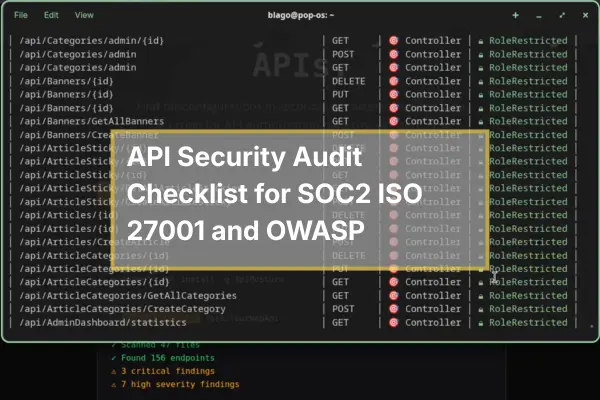
ApiPosture Pro automates the detection of these gaps by scanning your method bodies (Rule AP101). Instead of manually checking every controller, you can generate a report showing that every data-writing operation is protected by a verified authorization check.
CC7: System Operations and Monitoring
CC7 requires that you monitor your systems to identify anomalies and security incidents. From an API perspective, this involves identifying Shadow APIs and ensuring that all destructive operations (DELETE/PUT) are properly logged for auditability.
A major audit risk is the "orphaned endpoint"—a route created for testing that was never removed. These endpoints rarely appear in your Swagger UI but exist in your compiled code. ApiPosture's static analysis engine discovers these routes by inspecting your controllers directly, ensuring your monitoring scope covers 100% of your actual attack surface.
Scan identified 14 endpoints performing DbContext.Remove() without an associated ILogger call or audit trail.
Risk: CC7.2 violation. If data is deleted by an attacker or a malicious insider, there is no forensic trail to identify the "Who, When, and What."
Solution: Implement an Interceptor or Middleware to log all destructive API calls.
CC8: Change Management and Risk Assessment
CC8 focuses on how you manage changes to your environment. For software teams, this means your CI/CD pipeline must act as a gatekeeper. To satisfy this criterion, you must demonstrate that security testing is part of your development lifecycle (SDLC).
By integrating ApiPosture into your build pipeline, you create a "Compliance-as-Code" environment. Every time a developer introduces a new API route, it is automatically assessed against OWASP Top 10 rules. If a security misconfiguration is detected, the build fails, and the change is blocked until remediation occurs. This provides a clear, high-integrity audit trail for your SOC 2 assessor.
Mapping API Vulnerabilities to SOC 2 Criteria
Vulnerability | SOC 2 Criterion | Detection Rule |
|---|---|---|
Broken Authorization (BOLA) | CC6.1 (Logical Access) | AP101 |
Hardcoded Secrets | CC6.1 (Data Protection) | AP201 |
Missing Audit Logs | CC7.2 (Monitoring) | AP107 |
Permissive CORS/HTTPS | CC6.6 (Boundary Protection) | AP105 |
Conclusion: Automating the Audit Burden
The goal of API security SOC 2 compliance is not just to pass the audit, but to build a resilient architecture that protects your customers. By mapping your technical controls directly to the Common Criteria, you turn security from a bottleneck into a business enabler.
With ApiPosture Pro, you can move from "point-in-time" audits to "continuous compliance." Our local-first analysis ensures that your most sensitive security findings stay on your machine, satisfying both the auditor and your internal security team.
Get Started with ApiPosture Pro »
Technical Resources & Security Guides
Deep Dive: To understand how specific security rules map to compliance frameworks like SOC 2, read our Technical Guide on ISO 27001 API Security Controls.
Vulnerability Research: Since authorization failures are a major audit risk, explore our architect's manual on Preventing BOLA in Modern API Environments.
Data Protection: Learn how to abstract sensitive PII and PCI data from your audit scope in our guide to Tokenization Data Security Best Practices.
Contract Security: Discover how to use OpenAPI specifications as a security contract by Hardening OAS API Definitions.