Architecture & Security
Most teams track the APIs they intend to expose. They don't track the ones they forgot about. Shadow APIs ship without review. Zombie APIs survive long after the features that needed them are gone. Both sit on the network, unmonitored, unpatched, and waiting. Sprawl is not an organizational failure. It's a security vulnerability.
What API Sprawl Is
API sprawl is the accumulation of endpoints that exist in production but live outside your team's awareness or control. The API gateway lists forty routes. The actual application responds to eighty. The forty nobody catalogued are your attack surface.
Two categories dominate the problem: shadow APIs and zombie APIs. They have different causes and different risk profiles, but the same consequence — endpoints that receive no security attention because nobody knows they're there.
Shadow APIs
A shadow API is an endpoint that reached production without going through your standard review, documentation, or gateway registration process. It isn't hidden by intent. It slipped through.
Common origins:
Debug and diagnostic routesA developer adds /api/debug/config during a tricky production incident. It dumps environment variables. The incident resolves. The route doesn't ship out with it.
Internal service endpoints exposed externallyA microservice exposes an admin interface for internal tooling. A misconfigured ingress rule makes it reachable from the public internet. The team never registered it because it was "internal."
Auto-generated framework routesFrameworks and libraries register their own routes — health checks, management endpoints, scaffolded CRUD. These appear in the running application but not in any human-maintained API document.
Third-party integrations with embedded endpointsYou add a payment SDK. It registers webhook verification routes on your server. You didn't write them, you didn't review them, and they accept external POST requests.
Zombie APIs
A zombie API was documented once. It's no longer needed. It's still running.
They appear after migrations, product pivots, and feature removals. The new version ships. The old version keeps answering requests because removing it required a deployment and nobody scheduled one.
API version graveyard — both routes active in productionGET /api/v2/payments/{id} ← current, reviewed, maintainedGET /api/v1/payments/{id} ← three years old, nobody noticed it still works
The v1 endpoint predates your current auth model. It may use a weaker token scheme, skip the ownership check added in v2, or rely on a dependency that stopped receiving security patches. It receives real traffic from clients that never updated.
Zombie APIs don't announce themselves. You find them in access logs, in old integration tests that still pass, and in the occasional breach postmortem.
Why Sprawl Grows
Sprawl is a structural problem, not a discipline problem. The forces that create it are built into how teams ship software:
›Decentralized development. Microservices and autonomous teams ship independently. No single team has a complete picture of what's running.
›Asymmetric incentives. Shipping new endpoints is celebrated. Removing old ones is invisible work. Cleanup loses to features every sprint.
›Gateway and documentation drift. Teams register new routes manually. They forget to deregister old ones. The gateway and the running application diverge.
›Fear of breakage. Old endpoints might still have callers. Nobody is certain. Removing them feels risky. They stay.
The Security Consequences
Untracked endpoints don't receive security reviews. They don't get patched when vulnerabilities are found. They don't follow policy updates. Everything your security program does for known endpoints, sprawl bypasses entirely.
What attackers find in the gapsHardcoded credentials left in a debug endpoint that shipped three releases agoAn admin action reachable without authentication because it predates your auth middlewareA v1 endpoint using MD5 password hashing that v2 migrated away fromSQL queries built with string concatenation in a forgotten data export route
Attackers scan for these. Automated tools probe common version prefixes, debug paths, and management endpoints. What your team forgot, they document.
The worst sprawl vulnerabilities aren't sophisticated. They're old code that was never reviewed applied against your current user data.
Finding What You Have
You can't govern endpoints you haven't found. Build discovery into your process, not after incidents.
Static analysis of source codeRoute registration lives in source. Scanning the codebase for route declarations finds endpoints before they hit production — and finds the ones that shouldn't be there. This works regardless of language or framework: Express route definitions, Django URL patterns, Spring mappings, Rails routes, FastAPI decorators, and Laravel route files all declare routes in parseable, auditable source code.
Runtime traffic analysisAPI gateways and service meshes log every request. Query those logs for paths your inventory doesn't recognize. Anything generating traffic that your catalog doesn't list is a shadow endpoint.
OpenAPI/spec diffingGenerate your spec from code (not by hand) and compare it against what your gateway knows about. The diff is your shadow API list. Automate this comparison in CI so it runs on every merge.
Access log archaeologyPull 90 days of logs. Extract every unique path prefix that returned a 2xx or 3xx response. Cross-reference against your current route list. Paths in the logs but not in current code are zombie endpoints still answering from a prior deployment — or an undocumented secondary service sharing your domain.
Governance: Preventing New Sprawl
Discovery tells you what exists. Governance controls what gets added and removed going forward.
Treat the route inventory as a checked-in artifactGenerate the route list from source code and commit it to version control. A pull request that adds or removes endpoints produces a diff. Reviewers see it. Security sees it. The change is deliberate and traceable.
Block unregistered routes at the gatewayConfigure your API gateway to return 404 for any path not explicitly listed. An endpoint that exists in code but isn't registered is unreachable from the outside. Registration becomes mandatory, not optional.
Set retirement criteria for old versionsDefine a version sunset policy before you ship v2: v1 will be removed 90 days after v2 reaches general availability. Communicate it. Track it. Old versions that fall below a traffic threshold get a removal ticket, not an indefinite extension.
Scan in CI, not just in auditsSecurity reviews catch known problems at a point in time. Automated scans on every merge catch new problems at the moment they're introduced. The earlier you find an exposed debug route, the cheaper it is to remove.
Automated Detection
How ApiPosture Pro Finds the Endpoints You Forgot
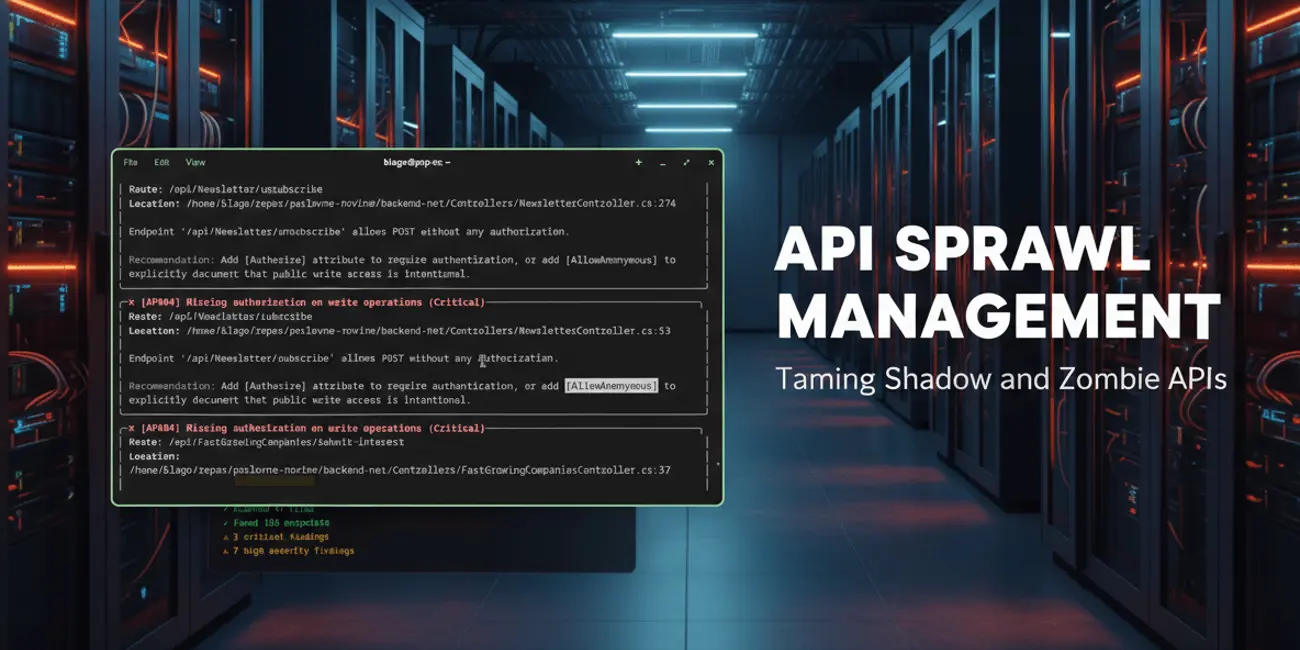
ApiPosture Pro scans API source code directly — no runtime traffic required, no gateway integration to configure. It reads route declarations and method bodies across your entire codebase, then applies security rules to everything it finds. That includes endpoints your documentation doesn't list.
›Secrets in forgotten endpoints — AP201 scans every method body for hardcoded credentials. Debug routes and old v1 handlers are common hiding places for API keys that never got rotated.
›Unauthenticated writes on shadow endpoints — AP101 flags public endpoints that perform database writes with no authorization check in the method body. Zombie admin routes that lost their middleware registration surface immediately.
›Old crypto in versioned endpoints — AP102 detects MD5 and SHA1 usage, hardcoded encryption keys, and reversible encryption applied to passwords. These patterns survive in v1 code long after v2 was upgraded.
›Injection vulnerabilities in stale routes — AP103 finds SQL queries built with string interpolation or concatenation. Zombie data-export endpoints built before parameterized queries became standard are common targets.
›Developer tooling exposed in production — AP105 detects Swagger/OpenAPI endpoints registered without an environment guard, debug exception pages, and permissive CORS policies that commonly appear in code added for local convenience and never removed.
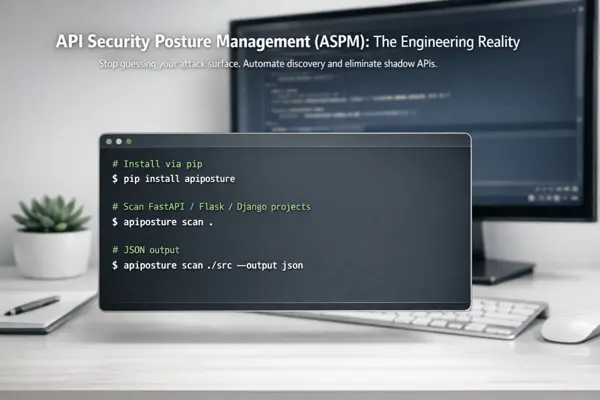
All analysis runs 100% locally — your source code never leaves your machine. Run apiposture-pro scan . against any service in your architecture to see exactly what security posture your forgotten endpoints carry. Add --fail-on high to your CI pipeline and sprawl stops being a silent problem.