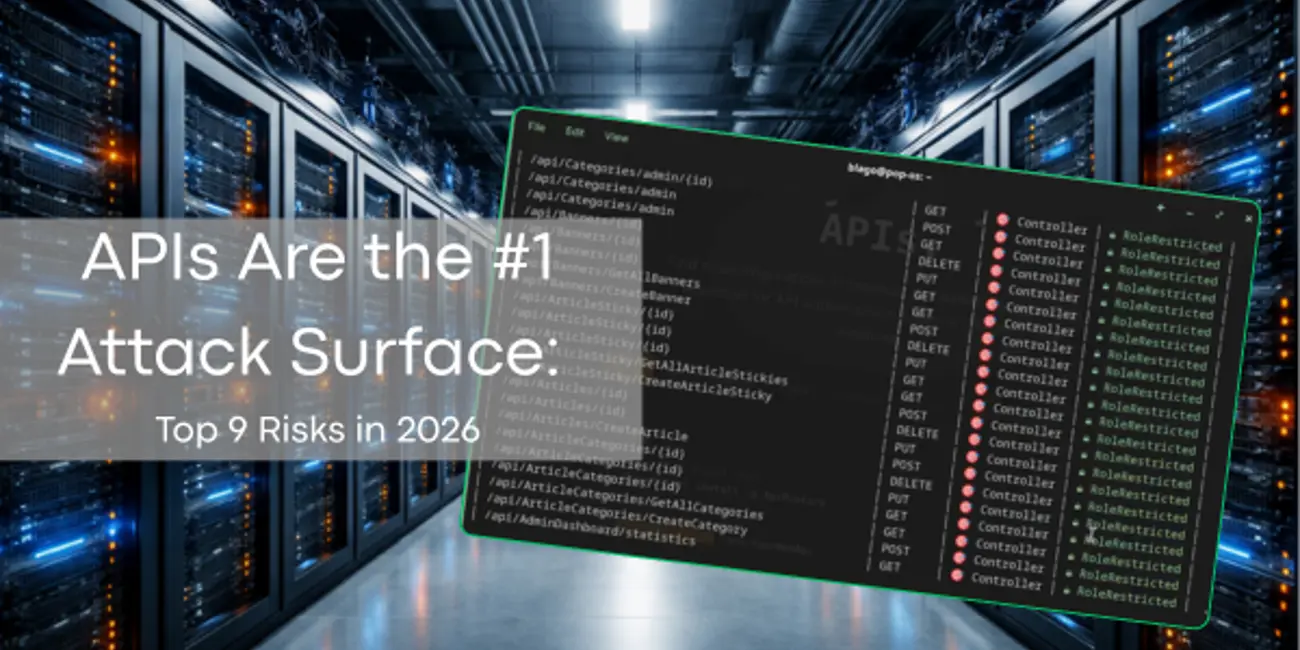
APIs Are the #1 Attack Surface: 9 of the Top Security Risks in 2026 Are API-Related
APIs now sit at the center of modern software delivery. They power SaaS platforms, mobile apps, microservices, customer portals, AI agents, internal tooling, and third-party integrations. For development teams, APIs make software faster to build, easier to extend, and simpler to connect. For attackers, they create direct access to business logic, sensitive data, authentication flows, and trust boundaries.
That is why API security has become one of the most urgent priorities for developers, platform teams, and DevSecOps leaders. As organizations ship faster and adopt AI-assisted development, they are producing more endpoints, more integrations, and more exposure than ever before. The result is clear: APIs have become the primary attack surface in modern applications.
According to the ApiPosture pitch deck by ScalarRatio, 9 of the top 10 security risks in 2026 are API-related in practice, including broken access control, misconfiguration, cryptographic failures, injection, insecure design, authentication failures, integrity failures, logging gaps, and poor handling of exceptional conditions. For teams building and operating modern applications, API security is no longer a nice-to-have. It is a core part of software delivery.
Why APIs Are the Biggest Security Risk Today
APIs are exposed everywhere. Every mobile session, frontend interaction, partner sync, webhook, background service, and AI workflow depends on them. The more digital products a company launches, the more APIs it creates. In fast-moving teams, that growth often happens faster than security can keep up.
The challenge is not only the number of APIs. It is the lack of visibility around them. Many engineering organizations do not have a complete, continuously updated inventory of their endpoints. They may not know which APIs are public, which are internal, which are deprecated but still active, or which contain weak authentication and authorization logic.
This is where API posture becomes a real DevSecOps concern. The attack surface grows through shadow APIs, zombie endpoints, inconsistent auth checks, overly permissive CORS settings, exposed debugging routes, and secrets leaking into logs or configuration. When release velocity increases and teams rely on AI-generated code, these risks multiply.
From a Google EEAT perspective, this topic also deserves practical depth. Teams do not need another vague warning about security. They need experience-based insight into how API vulnerabilities actually show up in production systems, how to reduce them, and which workflows make security usable for developers instead of disruptive.
The 9 API Security Risks Developers Need to Know
Most modern application risks now have an API dimension. Below are the nine issues developers and DevSecOps teams should treat as high priority in 2026 and onwards.
1. Broken Access Control
This remains one of the most common and dangerous API security problems. It happens when an endpoint allows a user to access data or actions they should not be able to reach. Common examples include insecure direct object references, missing ownership checks, and role-based access logic enforced only in the frontend instead of the backend.
2. Security Misconfiguration
APIs are often exposed with insecure defaults, verbose error responses, unnecessary HTTP methods, open CORS policies, or old staging routes left online. These issues are easy to overlook and often give attackers the reconnaissance they need before exploitation.
3. Cryptographic Failures
APIs regularly handle tokens, credentials, personally identifiable information, payment data, and internal service secrets. Weak encryption, poor key handling, missing TLS enforcement, or sensitive data exposure in transit and at rest can quickly turn an API into a breach path.
4. Injection
API inputs are a major source of injection risk. SQL injection, NoSQL injection, command injection, and template injection all become possible when input validation and output handling are weak. AI-assisted development may speed up coding, but it can also introduce insecure patterns when code is accepted without proper review.
5. Insecure Design
Some API risks are not bugs. They are design flaws. Missing rate limits, weak trust boundaries, poor privilege segmentation, and no abuse prevention model can all make an API insecure even when the code appears technically correct.
6. Authentication Failures
Improper token handling, weak session controls, missing re-authentication for sensitive actions, flawed refresh token flows, and inconsistent identity enforcement across endpoints can all expose APIs to account takeover and unauthorized access.
7. Integrity Failures
Webhooks, software supply chains, API payloads, and service-to-service interactions can all fail if integrity protections are weak. Unsigned payloads, unverified dependencies, and poor validation of inbound events can undermine trust across distributed systems.
8. Logging and Alerting Gaps
Many teams either collect too little information to investigate incidents or log too much sensitive data. Without API-specific visibility, suspicious behavior can go unnoticed until after damage is done. Good logging should support detection without creating new data exposure.
9. Mishandling Exceptional Conditions
Error handling is part of security. Stack traces, internal framework details, system messages, and inconsistent failure behavior can leak valuable information to attackers. Poor error handling can also create resilience problems that make abuse easier.
Why Traditional API Security Tools Slow Teams Down
Many legacy API security and application security tools were built for centralized security teams, not modern product engineering teams. They often assume longer release cycles, slower onboarding, and manual review processes. That model does not fit developer-led organizations shipping multiple times per day.
In practice, traditional tools often create friction in five ways. First, setup can take days or weeks. Second, the tools generate reports instead of code-level remediation. Third, findings arrive too late in the development cycle. Fourth, the signal-to-noise ratio is poor. Fifth, they are designed around enterprise sales and security ownership instead of daily developer workflows.
For DevSecOps teams, this creates a recurring problem: security becomes a bottleneck instead of an enabler. Developers do not want another dashboard. They want fast feedback, real context, and clear fixes that fit into their existing workflow.
Legacy API Security Approach | Modern API Posture Approach |
|---|---|
Weeks to deploy | Fast setup inside existing dev workflow |
Static reports | Actionable code fixes |
Security-team owned | Developer-first and DevSecOps-friendly |
Periodic audits | Continuous API discovery and scanning |
Enterprise-heavy pricing | Low-friction self-serve adoption |
How APIPosture Helps Developers Secure APIs Faster
One of the biggest gaps in many API security articles is that they describe the problem well but fail to explain what a modern solution should actually do. This is where APIPosture stands out. Based on the ScalarRatio deck, the product is positioned as a developer-first API security scanner built for speed, usability, and actionable remediation.
2-minute setup without slowing engineering teams down
APIPosture is designed for low-friction onboarding. The pitch deck highlights a two-minute setup flow, which matters because adoption is often the hardest part of security tooling. If getting started requires weeks of configuration, developers delay it. If the tool fits naturally into repo-based workflows, teams use it earlier and more often.
Sub-second API discovery and visibility
The deck also emphasizes sub-second discovery. That matters because the first challenge in API security is visibility. Teams need to know what endpoints exist, where vulnerabilities live, and which routes may be undocumented, exposed, or misconfigured. Fast discovery makes API posture management more practical for real-world development teams.
Actionable fixes instead of static reports
One of the strongest product messages is the shift from “what’s wrong?” to “here’s how to fix it.” That is highly relevant for developers. Security findings are only useful when they include remediation guidance that engineers can apply quickly. APIPosture positions itself around ready-to-use code remediations for developers and AI agents, which aligns well with modern DevSecOps workflows.
Built for compliance and DevSecOps use cases
The product flow in the deck includes connecting a repo or API endpoint, running an instant scan, mapping findings to SOC 2 and ISO requirements, and applying fixes via CLI or AI assistance. That bridge between engineering execution and compliance requirements is important. It gives security leaders and developers a shared path from issue discovery to remediation and audit readiness.
Designed for developer-first adoption
The deck’s positioning is clear: APIPosture is meant to serve developers first, not just centralized security teams. That aligns with how modern security programs actually scale. The most effective API security tooling does not wait for a quarterly audit. It helps developers catch and fix issues while they are still building.
What Developers Should Do Today to Reduce API Risk
Even with the right tooling, API security still depends on good engineering habits. For developers and DevSecOps teams looking to reduce risk now, these actions should come first.
Inventory every API endpoint: You cannot secure what you cannot see. Start by identifying all public, private, partner, internal, staging, and deprecated endpoints. Build a living API inventory, not a one-time spreadsheet.
Shift API security earlier in the workflow: Run API security scanning during development, pull requests, and CI/CD rather than after release. Security findings are cheaper and faster to fix when they are discovered before production.
Validate authorization on the backend: Do not rely on the frontend to enforce access rules. Check identity, role, tenant, and object ownership server-side on every sensitive route.
Review logging and secrets exposure: Inspect logs for leaked tokens, credentials, internal IDs, and sensitive payloads. Good observability should improve detection without creating a secondary data leak.
Harden authentication flows: Review token expiration, refresh mechanisms, session invalidation, service-to-service identity, and re-authentication on sensitive operations. Inconsistent auth logic across endpoints is a common API weakness.
Test error handling and abnormal conditions: Security testing should include malformed requests, permission edge cases, excessive rate attempts, and failure scenarios. APIs should fail safely without exposing implementation details.
Continuously monitor shadow APIs: As teams move fast, undocumented and legacy endpoints can remain exposed long after the owning engineer has moved on. Continuous scanning helps uncover these hidden risks.
Why API Security Is a Developer Experience Problem
API security is not only a technical challenge. It is also a developer experience challenge. If a security tool is slow, confusing, expensive, or disconnected from real development workflows, adoption suffers. When adoption suffers, risk grows.
The best DevSecOps programs understand that good security has to be usable. Developers want tools that integrate into the CLI, fit into CI/CD, provide clear output, and support rapid remediation. Security teams want assurance, policy alignment, and evidence for compliance. Leadership wants reduced risk without reduced velocity. Strong API posture platforms bring those needs together.
This is also where product credibility matters. APIPosture’s pitch deck presents a team that combines growth leadership with deep DevSecOps expertise, including API security knowledge and secure systems architecture. That matters from an EEAT perspective because expert-led products and practitioner-informed workflows tend to produce more useful security outcomes for real teams.
Frequently Asked Questions About API Security
Why are APIs the biggest security risk today?
Because APIs expose direct access to application logic, data, authentication flows, and integrations. As software becomes more API-driven, the number of possible entry points for attackers increases quickly.
What is API posture management?
API posture management is the process of continuously discovering APIs, identifying vulnerabilities and misconfigurations, understanding exposure, and helping teams remediate risk over time.
How often should APIs be scanned?
APIs should be scanned continuously or at least during major code changes, pull requests, and release workflows. Quarterly reviews are no longer enough for fast-moving development teams.
What is the difference between API security testing and API posture management?
API security testing usually focuses on finding vulnerabilities at a point in time. API posture management is broader. It includes visibility, inventory, misconfiguration detection, policy mapping, and continuous remediation support.
Can API security be automated in CI/CD?
Yes. In fact, it should be. Modern API security tools are most effective when they are integrated into development and delivery workflows so issues are discovered before production deployment.
Conclusion
APIs are no longer a secondary concern in application security. They are now the primary attack surface across SaaS, mobile, AI, and cloud-native systems. In 2026 and onwards, developers and DevSecOps teams must assume that most meaningful security weaknesses will involve APIs in some way.
That means the old model of slow onboarding, static reports, and security-team-only ownership is no longer enough. Teams need API security tools that are fast to deploy, easy to use, capable of continuous discovery, and focused on actionable fixes.
That is the opportunity APIPosture is aiming to capture. By combining fast setup, sub-second discovery, developer-first workflows, compliance mapping, and actionable remediation, it speaks directly to the needs of modern engineering teams. If your organization is shipping fast but lacks real-time API visibility, a modern API security scanner can help reduce risk before it reaches production.
In practical terms, API security is no longer separate from software delivery. For modern DevSecOps teams, it is software delivery.
Secure your APIs in minutes with developer-first scanning. Not sure yet? Experience for yourself with our free community edition.


