Engineering Deep Dive
Application Programming Interface Security: The No-BS Guide for Engineers
Stop relying on perimeter "magic." Secure your code where it lives.
Effective application programming interface security is not a product you buy; it is a discipline you bake into your CI/CD pipeline. In the "Enterprise Bloat" era, security vendors try to sell you heavy agents, sidecars, and SaaS dashboards that do nothing but alert you to problems three weeks after you've pushed to production. Real application programming interface security happens in the IDE and the build runner. If you aren't catching OWASP API Top 10 vulnerabilities before the container is even built, you are playing a losing game of catch-up.
1. The Crisis of API Sprawl and Documentation Rot
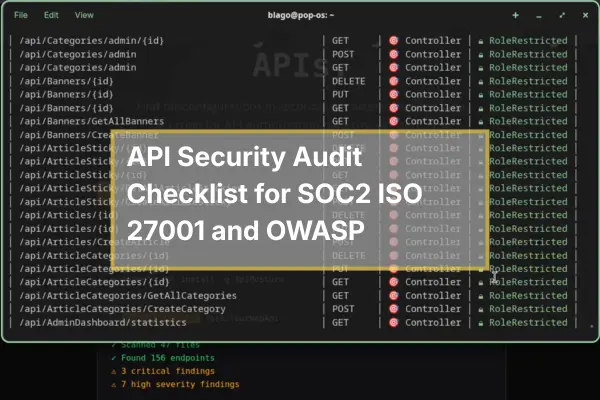
Every modern system suffers from API Sprawl. It starts with a simple microservice. Then comes the "temporary" internal endpoint for the frontend team. Then the legacy v1 route that was never decommissioned. Before you know it, your attack surface is 40% larger than what is documented in your OpenAPI/Swagger spec.
Perimeter-based Runtime Protection cannot protect what it doesn't know exists. If an endpoint isn't in your gateway's whitelist, it's a "shadow API." High-authority application programming interface security requires tools that scan the actual source code to discover every route, every controller, and every
[HttpGet] attribute, ensuring that the Remediation happens at the source.2. Breaking Down the OWASP API Top 10 for Devs
Let’s look at the most critical application programming interface security risks through the lens of a .NET engineer.
API1:2023 Broken Object Level Authorization (BOLA)
BOLA is the king of API vulnerabilities. It occurs when a user can access a resource they don't own by simply guessing an ID. Typical "security" tools check if a user is logged in (Authentication), but they fail to check if they are authorized to see that specific object.
// VULNERABLE CODE (AP101)
[HttpGet("/invoice/{id}")]
public async Task<IActionResult> GetInvoice(int id) {
var invoice = await _db.Invoices.FindAsync(id); // No ownership check!
return Ok(invoice);
}
[HttpGet("/invoice/{id}")]
public async Task<IActionResult> GetInvoice(int id) {
var invoice = await _db.Invoices.FindAsync(id); // No ownership check!
return Ok(invoice);
}
API2:2023 Broken Authentication
This includes application programming interface security failures like weak password hashing (MD5/SHA1), exposed tokens in logs, or failing to rotate keys. ApiPosture Pro detects these patterns (AP102) by scanning your method bodies for
MD5.Create() or hardcoded JwtSecurityToken configurations.3. Comparison: Why Local Static Analysis Wins
Most "Enterprise" application programming interface security platforms require you to upload your swagger files to their cloud. That’s a security risk in itself. We believe in the "Local-First" engineering philosophy.
Feature | ApiPosture Pro | Standard SaaS |
|---|---|---|
Setup Effort | 1 CLI Command | Weeks of configuration |
Data Privacy | 100% Local | Code/Spec leaves your network |
Scanning Speed | Sub-second | Minutes/Hours |
4. Securing the CI/CD Pipeline
Manual audits are where application programming interface security goes to die. If you aren't automating your security checks, you aren't doing CI/CD security. You're just doing "Development with occasional panic."
ApiPosture allows you to integrate security directly into your GitHub Actions or Azure DevOps pipelines. Use the
--fail-on flag to ensure that no developer can merge a PR if it contains an Injection Vulnerability (AP103) like ExecuteSqlRaw with string interpolation.apiposture scan ./src/Api --fail-on critical --output markdown5. Advanced Remediation: More than just "Find"
Most tools stop at finding the bug. ApiPosture Pro's Remediation focus provides specific line-number references and AI-ready JSON outputs. Whether you are fixing it yourself or using a Copilot, having a precise mapping of the vulnerability in the Roslyn syntax tree makes the fix trivial.
AP105: Permissive CORS — Stops the "lazy"
.AllowAnyOrigin() configuration that opens your API to CSRF.AP108: SSRF Protection — Detects
HttpClient patterns that allow attackers to probe your internal network.AP201: Secret Detection — Scans method bodies and appsettings for connection strings and API keys before they are committed.
Conclusion: Own Your API Security
The future of application programming interface security is shift-left, local-first, and bloat-free. Stop paying for dashboards that your engineers ignore. Start using tools that speak their language. Secure your OpenAPI/Swagger definitions, eliminate API Sprawl, and build Runtime Protection into the logic of your code.
Scan your API in the next 60 seconds
No signup. No cloud. Just security.