Essential API Security Controls for Compliance Audits
For modern enterprises, the question is no longer *if* you have security, but whether your API security controls are verifiable. During a SOC 2 Type II or ISO 27001 audit, broad claims about "cloud security" fall short. Auditors demand to see the granular, technical mechanisms that protect data as it flows through your application programming interfaces.
An effective compliance posture requires a multi-layered approach. You must prove that you can identify who is calling your API, what they are allowed to do, and that you are monitoring every significant action. Without these controls in place, your API becomes a "compliance black hole" where unauthorized data access can go undetected for months.
This guide outlines the five pillars of API security controls required for modern compliance and explains how to automate the most difficult part of the audit: Authorization Verification.
1. Authentication (AuthN): Identity Assurance
The first of the API security controls is identity verification. In an enterprise environment, this typically involves OAuth 2.0 or OpenID Connect (OIDC). Auditors check for strong token validation—ensuring your API verifies the signature, issuer, and expiration of every JWT (JSON Web Token).
A common audit failure is the "Leaky API," where developers accidentally expose public endpoints that should have been protected by the [Authorize] attribute. Automated scanning is the only way to ensure 100% AuthN coverage across hundreds of routes.
2. Authorization (AuthZ): The Verification Layer
While Authentication confirms *who* the user is, Authorization defines *what* they can see. This is the most complex control to implement and verify. Standard identity providers cannot tell if User A is allowed to edit Project 505—that logic lives deep inside your C# code.
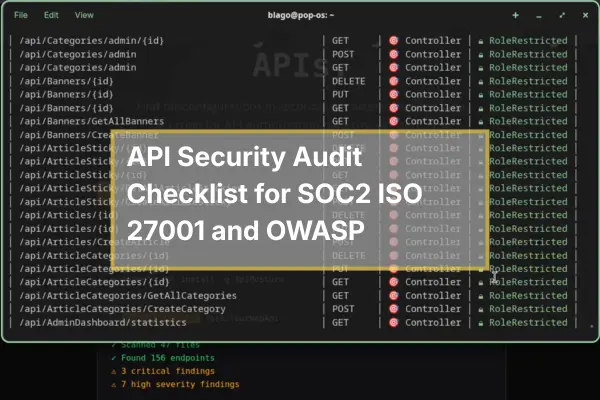
ApiPosture Pro serves as the authorization verification layer. It doesn't just check for a login; it inspects the method body to ensure that database queries include an ownership check. If your code retrieves a record based solely on a user-provided ID without verifying the requester's rights to that specific object, ApiPosture flags it as a BOLA (Broken Object Level Authorization) risk.
By using static analysis to verify AuthZ, you provide auditors with "proof of logic," demonstrating that your API security controls are enforced at the data layer, not just the perimeter.
ApiPosture inspects your ASP.NET Core Controllers for "Naked Writes"—database updates that occur without an OwnerID or TenantID filter in the Where clause.
Compliance Value: This satisfies the "Principle of Least Privilege" required by SOC 2 CC6.1 and ISO 27001 A.9.4.2.
3. Rate Limiting & 4. Logging
Rate Limiting: Availability is a core Trust Service Criterion. Without rate limiting, your API is vulnerable to DoS attacks that can take your services offline. Auditors look for global or per-user limits enforced via middleware.
Logging: You cannot satisfy CC7.2 (Incident Monitoring) without a robust audit trail. Every DELETE, PUT, and POST request must be logged with the timestamp, actor, and outcome. ApiPosture Rule AP107 specifically checks for destructive methods that lack an ILogger call, helping you close logging gaps before they hit production.
5. Vulnerability Detection: Continuous Assessment
Compliance isn't a one-time event; it’s a continuous state. Vulnerability detection is the control that ensures all other API security controls are working correctly. This involves scanning for SQL injection (API3:2023), insecure deserialization, and misconfigured CORS policies.
By integrating vulnerability detection directly into your build pipeline, you meet the "Change Management" requirements of CC8.1. You provide a repeatable process for identifying and remediating risks before they can be exploited.
Control Mapping for Audit Readiness
Control Category | Technical Requirement | ApiPosture Verification |
|---|---|---|
Authentication | JWT/OAuth Enforcement | Rule AP101 |
Authorization | Resource-Level Ownership | Verification Layer |
Logging | Audit Trail for Deletions | Rule AP107 |
Assessment | SAST/DAST in CI/CD | CLI Tooling |
Conclusion: Modernizing the Compliance Stack
Enterprise API security controls are evolving. Auditors are becoming more technically savvy, moving beyond documentation to inspect the actual implementation of security logic. By focusing on automated verification of your authentication, authorization, and logging, you reduce the time and cost of compliance audits while significantly improving your risk posture.
ApiPosture Pro provides the automated evidence you need to prove your APIs are secured by design. Start your assessment today and turn your security controls into a competitive advantage.
Get Started with ApiPosture Pro »
Technical Resources & Security Guides
SOC 2 Strategy: Learn how to map these controls to Trust Services Criteria in our Guide to API Security for SOC 2 Compliance.
OWASP Baseline: Discover why the Top 10 is the foundation of global compliance in How OWASP API Compliance Helps with Audits.
Vulnerability Deep-Dive: Authorization is the most critical control; master the prevention of BOLA Vulnerabilities in Modern APIs.
Global Standards: For organizations operating internationally, explore our Technical Guide on ISO 27001 API Security Controls.