How to Secure APIs for GDPR Compliance
The General Data Protection Regulation (GDPR) has fundamentally altered the definition of "quality" in software engineering. We no longer live in an era where security is a separate concern from feature delivery. For modern distributed systems, the API layer serves as the primary gateway for Personal Identifiable Information (PII). It is the point of highest risk, where a single misconfigured controller can result in a catastrophic data leak.
To achieve GDPR API compliance, engineering teams must move beyond reactive measures. Traditional security models—which rely on external penetration testing or manual compliance spreadsheets—cannot keep pace with continuous deployment cycles. Instead, organizations must adopt a Privacy-by-Design approach. This guide explores how to use automated static analysis to identify PII exposure, authorize data access at the object level, and maintain a continuous inventory of processing activities.
1. Personal Data Exposure via APIs
The principle of Data Minimization (GDPR Article 5) requires that personal data be limited to what is strictly necessary for the purpose of processing. In the world of REST and GraphQL APIs, the most common violation is Over-fetching.
Developers often return full database entities in a response to avoid the "boilerplate" of creating Data Transfer Objects (DTOs). While this speeds up development, it creates a massive privacy liability. If your User entity contains a PasswordHash, SocialSecurityNumber, or LastLoginIp, returning that object directly to the client—even if the UI hides those fields—constitutes a data breach under GDPR.
Vulnerability: Direct Entity Exposure
Static analysis identifies this by tracing the flow from the DbContext (Source) to the ActionResult (Sink) without an intermediary mapping step.
2. Unauthorized Endpoint Risks (API Sprawl)
GDPR Article 32 mandates that organizations implement appropriate technical and organizational measures to ensure a level of security appropriate to the risk. You cannot secure what you do not know exists. API Sprawl—the proliferation of undocumented or "shadow" endpoints—is the primary cause of unauthorized data access.
Common sprawl risks include:
Legacy Versions: Keeping
/api/v1/active afterv2is deployed, where the old version lacks modern authentication.Debug Routes: Internal-only routes like
/api/admin/dump-logsthat accidentally become public.Method Misuse: A
GETendpoint that modifies data, bypassing CSRF protections.
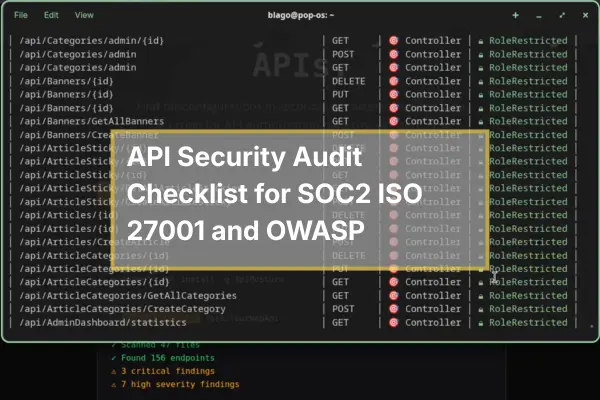
To maintain API personal data protection, your security strategy must include a "Continuous Inventory." ApiPosture Pro achieves this by scanning your ControllerBase definitions and [Route] attributes to create a living map of your API surface area, ensuring no endpoint remains hidden from auditors.
3. Access Control Requirements under GDPR
GDPR emphasizes Integrity and Confidentiality. At the API level, this manifests as a requirement to prevent Broken Object Level Authorization (BOLA). BOLA occurs when an API endpoint uses an ID from user input to access a resource, but fails to verify that the requesting user actually owns that resource.
Under GDPR, a BOLA vulnerability isn't just a bug; it is a lack of technical control. If User A can access User B's medical records by changing /records/101 to /records/102, the organization has violated the Privacy-by-Design (Article 25) mandate.
How ApiPosture Prevents BOLA (Rule AP101)
Static analysis doesn't just check for the [Authorize] attribute. It performs logic-aware inspection of the method body. It identifies database queries (Entity Framework, Dapper, etc.) and checks if they are "scoped" to the current user's ID. If a query fetches a record by a primary key without a secondary check for UserId or TenantId, it flags a Critical risk.
4. How Static Scanning Prevents Data Leaks
Static Analysis (SAST) is uniquely capable of ensuring GDPR API compliance because it analyzes the Intent of the code before it is ever executed. This is the ultimate expression of "Shifting Left."
Traditional DAST (Dynamic Analysis) tools act like a blind explorer, trying different URLs to see what happens. SAST, like ApiPosture Pro, acts like an architect reading the blueprints. It can find vulnerabilities in code paths that are rarely exercised, such as error handlers or edge-case conditionals, which are often where PII leaks hide.
Continuous Evidence (Article 30): GDPR requires a "Record of Processing Activities." Manual documentation is expensive and quickly becomes obsolete. Using the apiposture --output markdown command allows engineering teams to generate audit-ready documentation in seconds, providing legal teams with the technical proof they need for compliance officers.
The Engineer’s GDPR Roadmap: 5 Steps to Compliance
Baseline your current environment. Run a scan to discover every public endpoint. Identify those that lack authentication or use the [AllowAnonymous] attribute. Every unauthenticated endpoint is a potential PII gateway that must be justified and documented.
Analyze your Data Transfer Objects. Ensure that database entities are never returned directly to the client. Use AutoMapper or manual projections to ensure only the minimum required fields are serialized into the JSON response.
A breach often occurs in the logs. Use Rule AP102 to detect if you are passing PII-rich objects to your ILogger. Ensure that logs contain correlation IDs, not credit card numbers or home addresses.
Enforce resource ownership. Every query must be tied to the ClaimTypes.NameIdentifier. Static analysis can verify this at scale across thousands of lines of code, where manual review would fail.
Integrate compliance into your pipeline. Set a rule to fail the build if a new "High" or "Critical" PII exposure is detected. This prevents non-compliant code from ever reaching a production environment.
GDPR-to-Code Mapping Matrix
GDPR Article | API Violation | Rule |
|---|---|---|
Art. 5 (Minimization) | Over-fetching / PII Leak | AP102 |
Art. 25 (By Design) | Missing Auth / BOLA | AP101 |
Art. 32 (Security) | Cleartext Logs / Injection | AP103 |
Art. 30 (Inventory) | Undocumented Shadow APIs | Audit Report |
Conclusion: Privacy as a Competitive Advantage
Achieving GDPR API compliance is no longer just about avoiding fines; it is about building trust with your users. In an era where data breaches are front-page news, having the technical controls to prove that your APIs are secure is a powerful competitive advantage.
By adopting a local-first, static analysis approach, you ensure that your source code never leaves your VPC while maintaining a rigorous security posture. ApiPosture Pro provides the precision required by engineers and the evidence required by legal teams.
Secure Your API Lifecycle
Automate GDPR API compliance without a single SaaS subscription.