How to Comply with the OWASP API Top 10 Using Static Security Analysis
The Problem: The Visibility Gap in API Security
Most security teams suffer from what we call "The API Visibility Gap." You have documentation for the APIs you *know* about, but your CI/CD pipeline is constantly deploying new endpoints, modified logic, and "temporary" testing routes. This API Sprawl is the number one cause of compliance failures. Traditional scanners wait until code is running; by then, the vulnerability is already exposed.
Compliance Requirement: Moving Beyond the Checklist
The OWASP API Top 10 requires organizations to not only identify vulnerabilities but to prove that they have a process for continuous monitoring. Specifically, criteria like API10:2023 (Unsafe Consumption of APIs) and API09:2023 (Improper Inventory Management) demand that you have a live, accurate view of your inventory and its associated risks.
1. Broken Object Level Authorization (BOLA)
API Security Risk
BOLA (formerly IDOR) occurs when an API endpoint does not validate that the user requesting a resource actually owns it. An attacker changes /api/orders/123 to /api/orders/124 and successfully retrieves someone else's sensitive data. This is the "Crown Jewel" for attackers and the most common reason for API security compliance audits to fail.
Technical Example
[Authorize]
public async Task<IActionResult> GetProfile(int id) {
// VULNERABLE: Found the record by ID, but never checked the OwnerId
var user = await _context.Users.FindAsync(id);
return Ok(user);
}
How to Detect the Issue
Dynamic scanners (DAST) struggle to find BOLA because they need two sets of valid credentials and a complex state to test. Static analysis, however, can trace the id variable from the route into the FindAsync call and flag the absence of a .Where(u => u.TenantId == currentTenant) clause.
How ApiPosture Helps
ApiPosture Rule AP101:
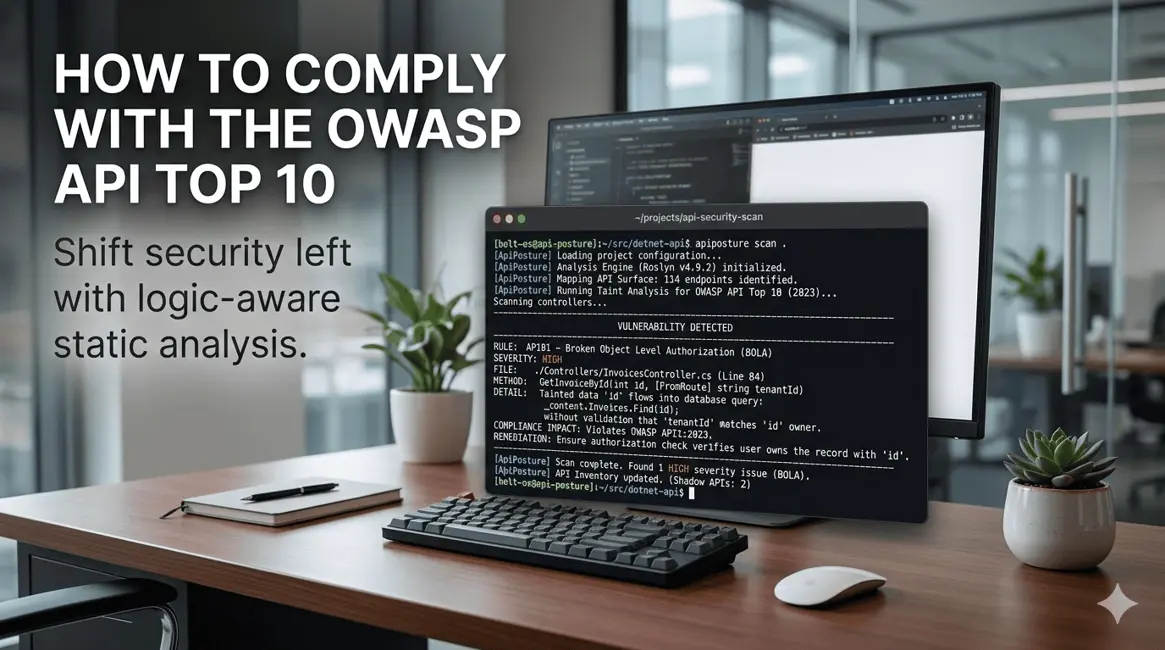
ApiPosture Pro performs deep source code inspection on the method body. It identifies "Sink" points where database operations occur and verifies if an authorization filter is applied to the query. By running this locally, you catch BOLA at the moment of commit.
[CRITICAL] AP101: Possible BOLA in ProfileController.cs:42. Resource 'id' used in DB query without ownership validation.
2. Broken Function Level Authorization (BFLA)
API Security Risk
BFLA is the "Admin/User" confusion. It happens when an administrative function (like DELETE /api/users/all) is reachable by a standard user because the developer either forgot an [Authorize(Roles = "Admin")] attribute or relied on "Security through obscurity" (assuming no one would guess the URL).
Technical Example
// VULNERABLE: No Role check. Any logged-in user can purge the DB.
[Authorize]
public async Task<IActionResult> PurgeData() { ... }
How to Detect the Issue
To detect BFLA, you need an OWASP API vulnerability scanner that maps the entire API surface and highlights endpoints where "destructive" verbs (PUT, DELETE, POST) are missing restrictive policy attributes. Manual review of thousands of endpoints is impossible; automation is the only way to ensure API security compliance.
How ApiPosture Helps
Risk Scoring & Authorization Mapping:
ApiPosture Pro cross-references all discovered routes against their defined authorization levels. It flags any endpoint with high-impact functionality that lacks explicit Role-based or Policy-based protection.
[HIGH] AP101: BFLA risk. Admin function 'PurgeData' lacks Role/Policy restriction.
3. Unauthenticated Endpoints (API Sprawl)
API Security Risk
The most dangerous endpoint is the one you forgot you had. API Sprawl leads to unauthenticated routes being left in the codebase—often testing tools or legacy data syncs—that are exposed to the public internet without a single layer of defense.
Technical Example
[AllowAnonymous]
// VULNERABLE: Accidental exposure of internal claims via AllowAnonymous
public IActionResult DebugInfo() { ... }
How to Detect the Issue
Use a tool that performs sub-second discovery of your entire routing table. By comparing the "Actual" state of your code to your "Documented" state (OpenAPI/Swagger), you can instantly see which endpoints are unguarded.
How ApiPosture Helps
Rule AP101 & Inventory Tracking:
ApiPosture Pro detects endpoints marked with [AllowAnonymous] or missing [Authorize] attributes. It generates an audit-ready list of every unauthenticated route, ensuring you satisfy the Inventory Management requirement of the OWASP API Top 10.
Static Analysis vs. The Competition
Conclusion: Security at the Speed of Code
OWASP API Top 10 compliance isn't a mountain you climb once a year; it is an ongoing engineering commitment. By utilizing deep static analysis, you can detect BOLA, BFLA, and injection vulnerabilities before they ever enter your deployment pipeline. ApiPosture Pro provides the Remediation intelligence required to fix issues in seconds, not weeks.
Automate Your Compliance Now
Run a local scan in under 60 seconds. No account, no SaaS, no bloat.