Compliance & Security
PCI DSS 4.0 API Requirements: Hardening the Payment Surface
A technical deep-dive into automated discovery, auth enforcement, and inventory management for v4.0 compliance.
PCI DSS 4.0 is no longer a checklist for the QSA; it is a mandate for the DevOps engineer. With the shift from 3.2.1 to 4.0, the focus has moved from "having a firewall" to "continuous proof of security." For teams handling cardholder data, PCI DSS 4.0 API Requirements necessitate a level of visibility that manual documentation cannot provide. API Sprawl and Shadow Endpoints aren't just technical debt anymore—they are compliance failures.
Requirement 12.5.2: The Death of Manual Inventories
One of the most significant changes in v4.0 is the explicit requirement for a comprehensive inventory of all system components. In the context of modern infrastructure, this means your OpenAPI/Swagger files must be accurate, up-to-date, and inclusive of every microservice that touches the CDE (Cardholder Data Environment).
If your inventory relies on a developer remembering to update a Wiki page, you will fail your audit. ApiPosture provides sub-second discovery by scanning your .NET source code to find every route actually compiled into your binaries. This ensures your PCI DSS 4.0 API Requirements for inventory are met with ground-truth data, not aspirational documentation.
Enforcing Authentication and the OWASP API Top 10
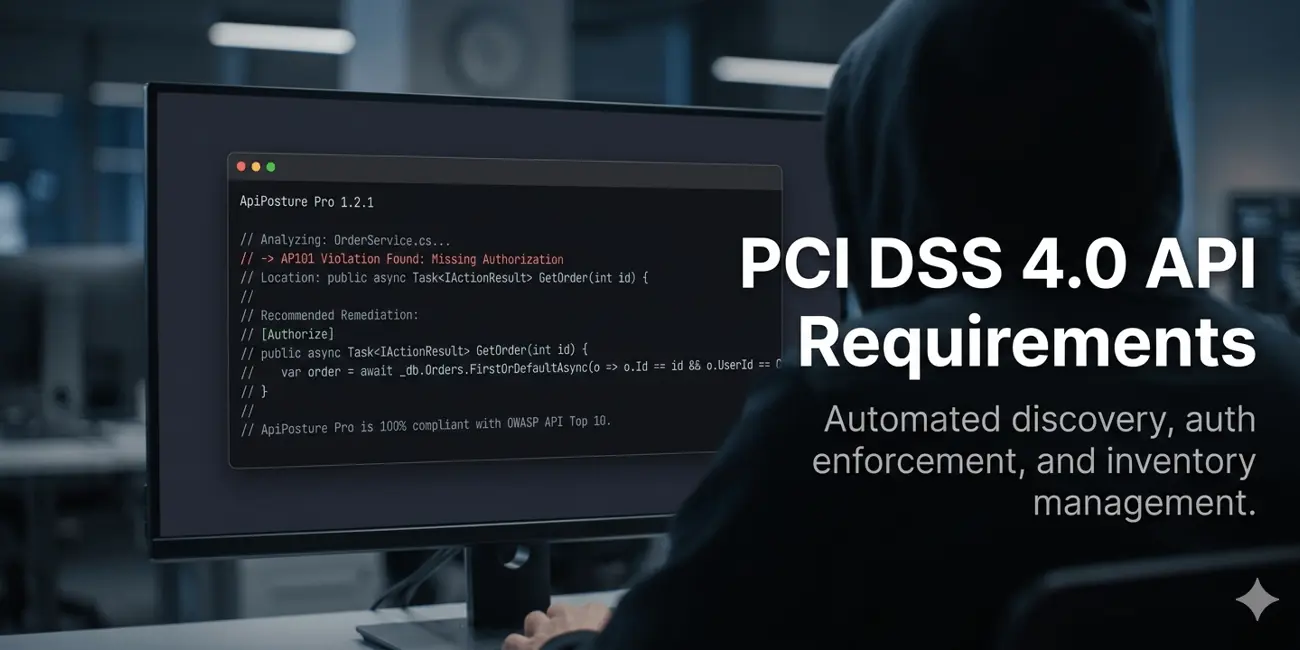
PCI DSS 4.0 emphasizes strong authentication (Requirement 8). For APIs, this means ensuring that every endpoint—especially those performing destructive operations—is guarded by robust authorization logic. Using ApiPosture Pro, you can automate the detection of Broken Object Level Authorization (BOLA) and missing [Authorize] attributes, mapping directly to PCI DSS 4.0 API Requirements.
Requirement 6.2.4: Injection Prevention
We detect ExecuteSqlRaw and string concatenation in DB queries that handle primary account numbers (PAN), preventing SQL injection at the source code level.
Requirement 3.4.1: Cryptographic Failures
Our AP102 rule flags weak hashing (MD5/SHA1) and hardcoded encryption keys in your appsettings.json, ensuring card data is never protected by obsolete algorithms.
Market Comparison: Compliance Speed
Compliance Feature | ApiPosture Pro | Legacy Scanners |
|---|
v4.0 Inventory Accuracy | Automated via Source Code | Manual / Traffic-based |
Local Data Handling | 100% Local (CDE stays local) | Cloud (Data leaks risk) |
Continuous Monitoring | Every CI/CD Build | Quarterly Scans |
Integrating PCI Compliance into CI/CD
The most "cynical" way to handle PCI DSS 4.0 API Requirements is to make them impossible to break. By adding ApiPosture to your CI/CD security pipeline, you treat compliance as a failing test. If a developer attempts to commit an endpoint with AllowAnonymous that accesses the Payments table, the build fails.
# PCI Compliance Check in GitHub Actions
- name: ApiPosture Scan
  run: apiposture scan --fail-on high --output markdown > compliance-report.md
# Result: Actionable Remediation for the Dev
[Finding] AP105: Swagger exposed in Production.
Fix: Wrap app.UseSwagger() in if (app.Environment.IsDevelopment())
Runtime Protection is not enough
Relying solely on Runtime Protection for PCI compliance is a high-stakes gamble. WAFs can be bypassed, and agents can crash. API Posture Management ensures the application is secure by design. When you combine static Remediation with your existing security stack, you move from "defense in depth" to "security in code."
Automate Your PCI v4.0 Readiness
Get sub-second discovery and actionable fixes today. No enterprise bloat.