Strategy & Implementation
Proactive API Security: Early Vulnerability Detection
Stop Reacting to Breaches and Start Blocking Vulnerabilities at the Source
Reactive security is a failed strategy. If you are waiting for a Web Application Firewall (WAF) to catch a BOLA attack or a DAST scanner to find an exposed endpoint in staging, you've already lost. Proactive API security requires shifting detection into the IDE and the CI/CD security pipeline. By identifying risks before code is even compiled, you eliminate the "security tax" of late-stage remediation.
The Fallacy of "Runtime-First" Security
Runtime Protection is a necessary safety net, but it's computationally expensive and prone to bypasses. A WAF sees the request, but it doesn't see the code. It doesn't know that your
/api/orders/{id} endpoint lacks an ownership check. Early vulnerability detection involves deep source-code inspection to identify these logical flaws. When security is "proactive," it becomes a quality gate—just like unit tests.DevSecOps Reality Check
Most "Enterprise" scanners take 20 minutes to run. Engineers bypass them. Proactive security only works if it's sub-second. If the scan isn't faster than your
dotnet build, it won't stay in the pipeline.Eliminating API Sprawl with Static Analysis
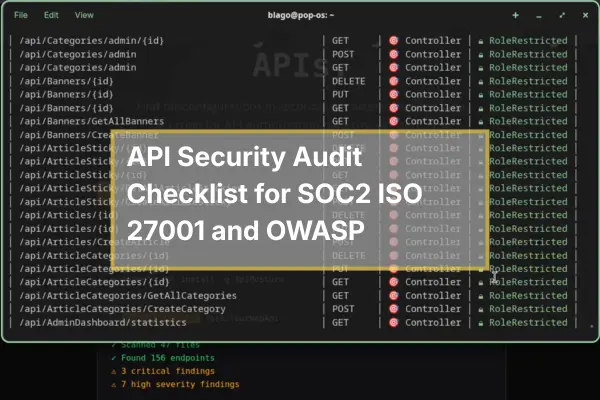
The greatest threat to API integrity is API Sprawl. Shadow endpoints—internal tools or debug routes accidentally left in production—are the primary targets for the OWASP API Top 10. Proactive detection tools don't just rely on OpenAPI/Swagger files; they scan the actual controller logic to find what's really exposed.
› Discovery — Instantly map every route defined in your C# code, including those missing from documentation.
› Contextual Analysis — Validate that high-risk operations (DELETE/PATCH) are protected by specific auth policies.
› Remediation Feedback — Provide direct file and line numbers so developers can fix the issue in seconds.
Competitive Edge: Setup Speed & Local Privacy
Proactive security shouldn't mean compromising your data privacy. While platforms like Snyk or 42Crunch require cloud connectivity, ApiPosture Pro runs locally. You get sub-second discovery and actionable fixes without your source code ever leaving your machine.
Feature | ApiPosture Pro | Snyk | 42Crunch |
|---|---|---|---|
Setup Time | < 2 Minutes | 15-20 Minutes | 30+ Minutes |
Cloud Dependency | None (100% Local) | Required | Required |
Discovery Speed | Sub-second | Minutes | Minutes |
Building a Proactive Culture
True proactive security is cultural. It requires moving away from periodic "security audits" and toward continuous automated verification. By treating your API security posture as a build-breaking metric, you ensure that every deployment is "secure by design."
For a technical implementation guide, check out our ASP.NET Core API Security Deep Dive.
Ready to automate your detection? Would you like me to generate a sample GitHub Action configuration for running ApiPosture in your pipeline?