SOC 2 Compliance for APIs: Automating the Trust Services Criteria
SOC 2 is the industry standard for proving you aren't playing fast and loose with customer data. For engineers, it's often viewed as a "tax" on productivity—a series of checkboxes mandated by the legal department. However, in an API-first world, SOC 2 Compliance for APIs is actually a technical challenge. If you can't prove who is accessing your endpoints or where your sensitive data is flowing, you don't have a compliance problem; you have a visibility problem.
1. Logical Access Control (CC6.1)
Problem
Developers often assume that because an API is behind a gateway or requires an `Authorization` header, it is secure. This leads to "Authorization Drift," where new endpoints are added without proper ownership checks.
Compliance Requirement
SOC 2 CC6.1 requires that logical access to software and data is restricted to authorized users. It isn't enough to check if a user is logged in; you must prove they are authorized to access the specific *resource* they requested.
API Security Risk
The primary risk here is Broken Object Level Authorization (BOLA). An attacker uses a valid token to request someone else's resource ID (e.g., `GET /api/orders/999` when they only own order 123). If your code doesn't validate resource ownership, you've violated SOC 2 CC6.1.
Technical Example
[Authorize]
public async Task<IActionResult> GetOrder(int id) {
// VULNERABLE: Fetches by ID without checking if it belongs to User.Identity
var order = await _db.Orders.FindAsync(id);
return Ok(order);
}
How to Detect the Issue
Traditional DAST tools fail here because they don't understand your business logic. You need static analysis that can trace variables from the URL parameter down to the database query logic to ensure an ownership filter exists.
How ApiPosture Helps
ApiPosture's AP101 rule performs deep source code inspection. It flags endpoints that use `[Authorize]` but lack internal resource-level authorization logic, providing the exact line of code needing remediation.
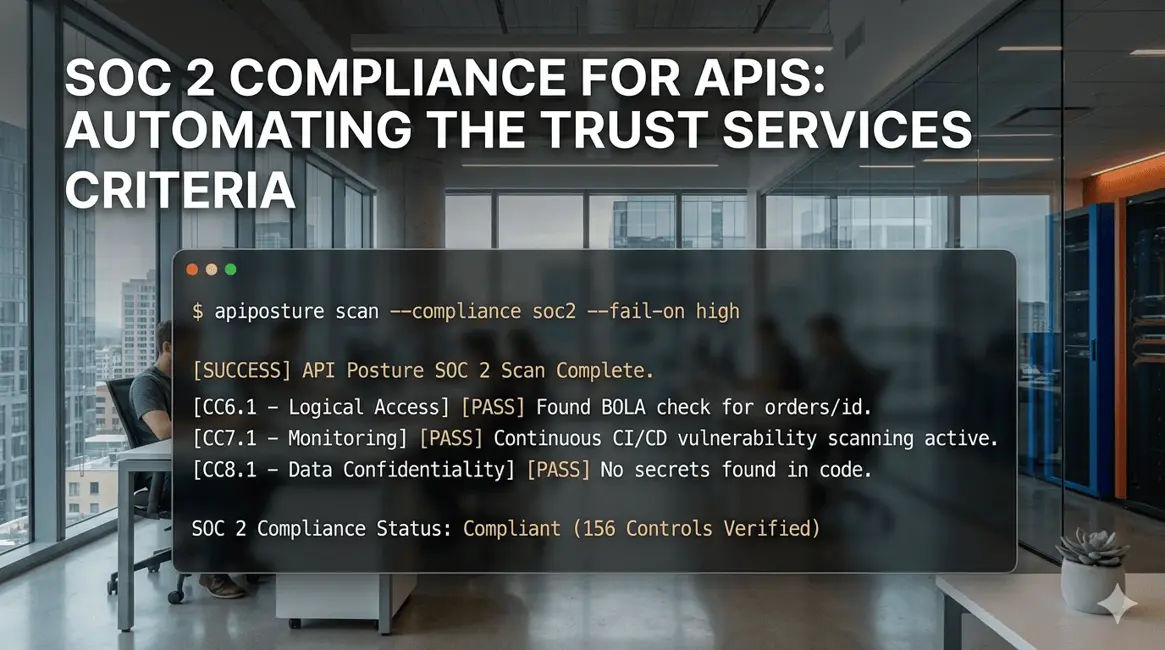
$ apiposture scan ./src --fail-on high[CRITICAL] AP101: Possible BOLA in OrderController.cs:24. Missing ownership check for 'id'.
2. System Monitoring & Vulnerability Management (CC7.1)
Problem
Modern CI/CD pipelines move too fast for manual security reviews. If a developer introduces a SQL Injection vulnerability, it might live in production for months before a quarterly pen-test finds it. This gap is a massive liability for SOC 2 Compliance for APIs.
Compliance Requirement
SOC 2 CC7.1 requires the entity to identify and evaluate changes that could significantly impact the system of internal control. In plain English: you must monitor for new vulnerabilities introduced during development.
API Security Risk
The risk is Injection (AP103). Specifically, the use of `ExecuteSqlRaw` with string concatenation or insecure deserialization via `BinaryFormatter`. These allow attackers to bypass all logic and extract the entire database.
Technical Example
var results = _db.Database.ExecuteSqlRaw($"SELECT * FROM Logs WHERE Category = '{userInput}'");
How to Detect the Issue
Scan for "sink" functions. You need to identify where untrusted input (from an API request) touches sensitive sinks (database, file system, process execution) without sanitization.
How ApiPosture Helps
ApiPosture integrates into your CI/CD in under 2 minutes. By using the CLI in your build pipeline, you turn security into a "unit test." If a developer writes a raw SQL string, the build fails, providing immediate Remediation guidance. This satisfies the CC7.1 requirement for continuous monitoring.
3. Confidentiality and Information Protection (CC8.1)
Problem
API logs are often a graveyard of PII. To debug a failed request, engineers frequently log the entire `Request` body. If that body contains a `Password`, `CreditCard`, or `SSN`, that data is now stored in unencrypted plaintext in your logging provider (Splunk, CloudWatch, etc.).
Compliance Requirement
SOC 2 CC8.1 requires that the entity protects confidential information from unauthorized disclosure. Leaking PII into logs is one of the most common reasons for a qualified (failed) SOC 2 report.
API Security Risk
Sensitive Data Logging (AP102). This includes both the logging of PII and the accidental inclusion of Secrets (API keys, connection strings) within the source code or configuration files.
Technical Example
_logger.LogInformation("Processing user: {User}", userObject);
How to Detect the Issue
You need a tool that understands the context of your data models. Identifying which properties are sensitive and ensuring they aren't passed to logging sinks is critical.
How ApiPosture Helps
ApiPosture Pro includes Secrets Detection (AP201) that scans method bodies, not just config files. It identifies hardcoded strings that look like entropy-heavy keys or sensitive data being passed into standard logging libraries, allowing you to intercept the leak before it hits production.
API Compliance Solution Comparison
Metric | ApiPosture Pro | Enterprise Bloat (42Crunch/Snyk) |
|---|---|---|
Audit Prep Time | < 2 Minutes | Days (Spec Mapping) |
Data Sovereignty | 100% Local (SOC 2 Friendly) | Requires SaaS Code Upload |
BOLA/Logic Analysis | Deep Body Inspection | Metadata Only |
Conclusion: Compliance as Code
SOC 2 Compliance for APIs is not about having a policy document that says you value security. It is about the evidence of your controls. By integrating a local-first, sub-second scanner into your workflow, you move from "Compliance Theater" to "Compliance as Code."
ApiPosture gives you the actionable fixes you need to satisfy auditors without slowing down your sprints. No agents, no heavy platforms, just results.
Audit-Ready in Seconds
Run your first scan locally and see the gaps in your SOC 2 API posture.